In Case You Missed It: AI in Philanthropy Part 2 - Major Gifts & Research (Mar. 10)
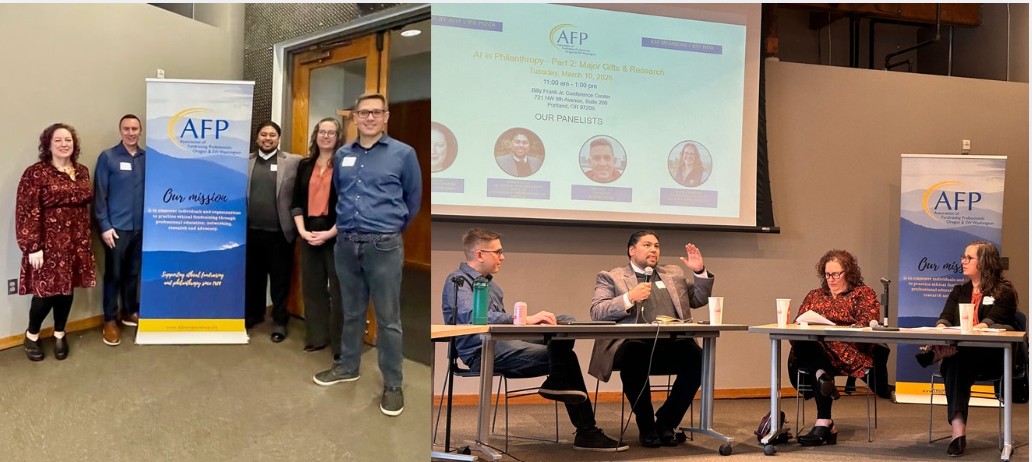
The AFP Oregon and SW Washington Chapter continued its "AI in Philanthropy" series with a panel discussion covering Major Gifts and Research. Moderated by Chapter President Anthony Petchel, MBA, CFRE, our panelists shared insights about how they are effectively utilizing AI in the course of their work in philanthropy.
It was a pleasure to have the following professionals join us:
Rachel Beck
Director of Development
Clark County Food Bank
Deriek Cruz
Senior Associate Philanthropic Officer, Providence Foundations
Jake Detels, MBA, PMP
Founder, Donor Facts
Alexis Ingram
Major Gifts Officer, Western Region, Wildlife Conservation Society
During the conversation, our moderator. Anthony Petchel, MBA, CFRE. invited panelists to respond to questions designed to explore how effectively using AI is transforming the work of major gifts officers. The responses demonstrated a spectrum of motivations for implementing AI in the course of their work. For Alexis, her use started with utilizing AI to personalize email communications with donors. For Rachel, the inspiration came from implementing a $10,000 grant provided to support the food bank’s network. For Deriek, AI made it possible to automate follow up with sponsors. For Jake, AI is integral to the work he has done in developing chatbots and creating an AI-driven platform for generating donor research.
In considering how to empower AI to do its best work, Rachel discussed the importance of training for tone and style. She found loading reports, grants, events, the AFP Code of Ethical Standards, CFRE Code of Ethics, and training the system in the tone of the CEO. Among other insights, Deriek shared that he found AI invaluable for role playing different donor scenarios. Jake provided context for how AI is developed and made the point that you should treat AI like an employee (e.g., be friendly!).
The panel dedicated time to discussing ethical considerations related to the uses of AI. Alexis expressed concern for the environmental impact especially on water usage caused by the energy consumption related to utilizing AI technology. Rachel shared the importance of protecting donors and developing policies that support that objective while protecting the company. She also cited the importance of developing rules for how employees utilize AI. Deriek spoke to the added element of navigating HIPAA rules and the importance of anonymizing donor information. Jake offered important guidance about “opting out” so that your organization’s data is not used to "train" the technology.
The discussion turned again to the importance of keeping ethics a focal point and creating policies to support the ethical use of AI in Philanthropy. Deriek described his organization’s official alignment for Microsoft Co-Pilot. He stressed that staff cannot access unvetted platforms. Rachel cited the importance of three pillars:
- Data Protection
- Human Oversight
- External Communications Approval
Thank you, Rachel, Deriek, Jake, and Alexis for being part of this important discussion!
A Message from Your Chapter President: How AI Is Shaping Philanthropy - March, 2026

Dear Colleagues,
There’s a lot of fear-based conversation about AI replacing jobs in nonprofits.
But a better question might be: Is AI taking the easy part of the job, or the hard part?
Take the taxi industry, for example. Google Maps or ridesharing apps did not replace driving. They removed friction, dispatch, payment processing, and navigation. The logistical part became easier, and taxi drivers no longer had to memorize maps of whole cities. The core service (getting someone safely from point A to point B), remained human. Technology replaced the hard part.
And how about accounting? Software like QuickBooks didn’t eliminate accountants. It automated calculations, reconciliation, and data entry. What remains valuable is judgment, interpretation, and strategic advice. The easy part was replaced, freeing up time for the hard part.
In fundraising, AI can handle the easy part:
- Drafting/improving emails
- Summarizing donor research
- Cleaning up call notes
- Pulling basic data insights
- Helping outline proposals or reports
Those tasks matter. But they are not the heart of fundraising.
The hard part (and possibly the most important part) is being human:
- Listening deeply to a donor’s values
- Building trust over time
- Navigating complex family dynamics
- Inspiring someone to invest in change
- Holding space for meaning, legacy, and purpose
AI cannot replace the authentic connection a fundraiser can have with a donor. It cannot replicate the emotional intelligence needed to sit across the table and build trust.
What AI can do is reduce friction.
If fundraisers use AI well, it becomes a capacity multiplier. It gives us back time and mental bandwidth to focus on what truly drives philanthropy: Relationships.
The risk is not that AI will make fundraising less human.
The opportunity is that it might allow us to be more human than ever.
With appreciation,
Anthony Petchel, MBA, CTP, CFRE
President, AFP Oregon and Southwest Washington Chapter